Thursday, January 27, 2022

Chief Raoni Metuktire


Chief Raoni Metuktire is the chief of the Kayapo people who populate a region of the Amazon forest.    It is this vast region in South America that represents a highly important resource that plays a central role in the stability of the global climate especially with the added threat of climate change that is a direct result of human activity.

The Amazon forest has been threatened for decades due to the unabated incursion of commercial development that has had a devastating impact on the the region – threatening the delicate ecological balance that sustains this natural system.  As a result, the livelihood, safety and security of the indigenous peoples that populate this region have been under continued assault.

Chief Raoni has been involved in the preservation of the remaining rain forest that is home to his people for decades and has repeatedly risked his own safety in the pursuit of this illusive goal.  Although there is no official record of his birth, it has been assumed that he was born around 1932 in a village called Krajmopyjakare, otherwise known as Kapot.  This village resides in the midst of he region referred to as the Mato Grosso in Brazil (see map below).


 The Kayapo are a nomadic people; as a child he lived in many locations.  At the age of 15, Raoni participated in the rites of initiation as a warrior and wore a labret – an ornamental disk in their lower lip that was gradually replaced by larger disks an ultimately reached the current size after four months.

In 1954, Raoni met the Villas Broas brothers – Orlando, Claudio and Leonardi were Brazilian activists that drew attention to the plight of the indigenous people of Brazil and ultimately succeeded in getting the upper Xingu legally protected.  He stayed with them for a year, learned Portuguese and was greatly influenced by them.

It was in 1973 that Chief Raoni began a friendship with noted French film maker, Jean Pierre Dutilleux, that ultimately led to the release of a documentary film entitled Raoni that was presented at the 1977 Cannes festival.  This gave the Chief Raoni and the plight of his people worldwide exposure.

He used this exposure as an opportunity to expose the threat the deforestation posed on the rain forest ecosystem and the plight this posed to the indigenous populations of this region.

In 1989, Chief Raoni, enlisted the help of Sting, a popular British rock band to broadcast his message.  It was the first time he ever traveled beyond his homeland of Brazil.  The resulting impact of all these events aroused enough global support that a vast tropical reservation was create in 1993 that encompassed the Mato Grosso and Para states in Brazil.  In addition, Chief Raoni won the support of such notable individuals as French President, Mitterrand and the former French President Chirac, The king of Spain, Juan Carlos and Pope John Paul II.

Chief Raoni Metuktire remains a charismatic and influential leader in support of the indigenous peoples of the rain forest and an outspoken proponent of a sustainable planet.

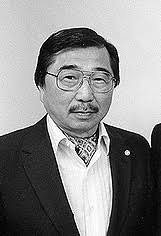
Gordon Hirabayashi


We have previously examined the life of Fred Korematsu, above, and have seen the degree of his courage in opposing the involuntary internment of Japanese-Americans during World War II. There was yet another individual, Gordon Hirabayashi, who openly defied Order No. 9066 that forcefully relocated so many Japanese-Americans, brutally uprooted them from their lives and livelihoods and for many their property as well.

Hirabayashi was born on April 23, 1918, in Sandpoint, Washington to Shungo and Mitsuko Hirabayashi who emigrated from Nagano Prefecture, Japan – a farming community. Shungo came to the United States in 1907 and was later to marry Mitsuko in 1914. It was an arranged marriage that was not uncommon in that era. Both Shungo and Mitsuko had studied at the Kenshi Gijuku Academy in Japan where they had learned English and eventually converted to the Christian religion. Rather than joining a conventional Christian mainline church they became followers of Kanzo Uchimura (1861 – 1930) who was responsible for founding the Mukyokai movement in Japan. The emphasis of this mode of Christianity proposed a non-liturgical approach to religious practice. It became known for its non-church services.

In 1891, Uchimura gained notoriety when, as a teacher at the First Higher School in Tokyo, he refused to bow before the signature of the emperor affixed to a copy of the new Imperial Rescript on Education. He later changed his mind and from a sickbed sent a colleague to bow for him, but the affair effectually ended his educational career. The Mukoyokai movement was pacifist in its orientation and stressed that behavior should reflect belief. It was apparently this ideology that inspired Hirabyashi to act in a way that lived up to his beliefs.

Once in America, Hirabayashi’s parents were instrumental with others in forming the White River Garden Corporation. In order to accomplish this, the Japanese-American members had to use a white intermediary on account of the fact that the Washington State Constitution had incorporated an alien land law in its founding documents in 1889. In 1921, this law was amended to make it impossible for aliens ineligible for citizenship to hold major shares in a corporation, hold property or hold any major interest in lands delegated for agricultural use. Because of this legal stipulation, the White River Garden Corporation lost its case in the Washington State Supreme Court and the farmland was ceded to the State, but the families involved were allowed to stay on the land and rent it from the State.

Given his unique Christian upbringing, he began to take a pacifist stance in regard to the growing conflict that was embracing Europe and Asia. By 1939 following the German occupation of Poland, the United Kingdom had declared war on Germany. As a consequence of these events, Hirabayashi as a young man registered with the Selective Service as a conscientious objector and joined the Religious Society of Friends, the Quakers, known for their long-standing pacifist theology.

Following the Japanese attack on Pearl Harbor on December 7, 1941, it was becoming quite evident that the United States domestic policy had begun to focus on Japanese-Americans as possible being a potential threat to domestic security. Finally, with the promulgation of Executive Order 9066, the military was given the responsibility of implementing the forced migration of Japanese-Americans living on the West Coast to hastily constructed internment camps.

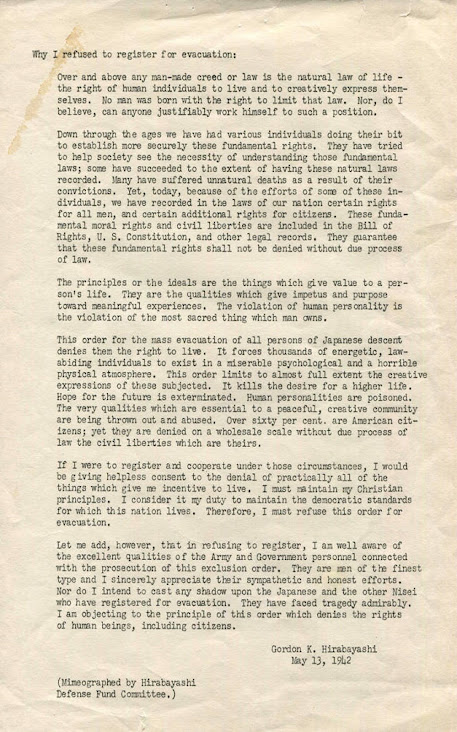
Realizing that his constitutionally mandated rights were being violated, he made the momentous and courageous decision to resist. When the time came requiring him to register for relocation, Hirabayashi turned himself in to the Federal Bureau of Investigation (FBI). His strategy was to create a test case as a way to challenge the underlying constitutionality of the federal mandate that ordered the forced incarceration of an entire group without due process of law. He had an underlying faith in the democratic system. He received a substantial amount of legal help and was eventually represented by Frank L. Waters. He was also supported by the American Friends Service Committee and Norman Thomas (1884 – 1968), the noted pacifist and leader of the Socialist Party of the United States for many years.

On May 13, 942, Hirabayashi wrote the following letter (see the image below) –


On May 28, 1942, Hirabayashi was indicted for violating Public Law 505 that made the violation of the mandated curfew imposed upon Japanese-Americans a federal crime. He was subsequently arraigned on June 1, 1942, at which time he pleaded not guilty based upon the legal argument that both the exclusion law and the curfew denied him basic constitutional rights as a citizen of the United States.

He ultimately lost this case and was sentenced to serve his allotted time in confinement at a road camp and ended up at a camp outside of Tacoma, Washington. When Hirabayashi’s legal team appealed this conviction to the Supreme Court, Hirabayashi v. United States, the justices by unanimous vote upheld his conviction on June 21, 1943.

He served his remaining time in a prison in Tucson, Arizona. There he met Hopi draft resistors and other pacifists like himself who refused military service on the grounds of being conscientious objectors. This experience reinforced his determination to resist.

Following his release from the federal prison in Tucson, he was faced with yet another challenge to his determination to resist what he believed were unconstitutional infringements on his personal liberty. He received a form from the Selective Service that came to be known as the “loyalty questionnaire (Form 304A). It was entitled, The Statement of United States Citizens of Japanese Ancestry

Since this form specifically singled out citizens of Japanese descent, he refused to fill it out and returned the blank form with a letter detailing his view regarding his view of the legitimacy of the questionnaire. His submission was ignored, and he was subsequently ordered to proceed to the CPS camp for induction. He refused induction. And was charged with Selective Service violations. In court, he represented himself, and was found guilty and was sentenced to one year at the McNeil Island Penitentiary.

After his release and following the end of the war, Hirabayashi completed his studies in sociology and with his advanced PhD degree, he taught abroad in Beirut, Lebanon, Cairo, Egypt, and Alberta Canada where he finally retired in 1983.


Ultimately, his wartime conviction was vacated by the Ninth Circuit Court of Appeals in 1987. This decision represented a repudiation of the extra-legal treatment of the Japanese-American population during the war.

In 1999, Hirabayashi was recognized for his courage and conviction in the face of the assault on his basic freedoms as a citizen of the United States by the renaming of the site of the Tucson Federal Prison in his honor to the Gordon Hirabayashi Recreation Site. In 2002, a kiosk was created that honored not only Hirabayashi, but also the forty-one Nisei draft resistors that were also sent to prison.

Hirabayashi died on January 2, 2012 and was subsequently posthumously awarded the Presidential Medal of Freedom by President Obama – a fitting acknowledgment to his contributions in living up to a central ideal of democracy – equal treatment of all under the law.

Wednesday, December 23, 2020

Holiday Message for the Coming Year - 2021

 The year 2020 has been in many ways disturbing and unsettling.  What, of course, comes to mind almost immediately is the COVID 19 pandemic that has claimed so many lives and has been so economically devastating to many facets of the national economy, and especially for those who have lost their livelihoods and businesses.  Added to this national burden are the deep fractures that have been exposed in regard to a national sense of unity, shared-mission and purpose.

Along with this overwhelming sense of loss, however, is the untold bravery, courage and unwavering energy displayed by so many who have risked their own lives and safety to come to the aid of all of us for the unselfish commitment to the greater good.  These individuals have come from many diverse positions - as doctors, nurses, emergency response teams, members of the police and fire departments and first responders of all kinds.  To this list, we should include all those responsible for providing food; for delivering the mail; for the taxi and bus drivers, train operators and pilots; for the teachers; for all those who care for the elderly and for all those who provide the essential services that we all too often take for granted.

My wish for the New Year (2021) is that we grow wiser from the events that have befallen us and see the future as a time for healing and learning from our collective missteps.  My hope is that the new year will be a time of new beginnings.  My dream is that we will finally come to recognize that regardless of our national origin, religious affiliation, skin color or sexual orientation we are all members of the same species with the same physical bodies, the same architecture of the brain, the same genetic makeup, the same constellation of feelings, of hopes and of dreams.  Each of us is worthy of the same opportunities to grow and develop as sentient beings on this most remarkable planet that also needs our kindness, care, and attention.  Earth is, after all, our only home.

Best Wishes to All

Wednesday, October 28, 2020

The Critical Need for a New Paradigm


The human species is in a state of perpetual crises. This has been made evident by the turmoil present within so many human societies throughout the globe. It has been this way since the very beginnings of human civilization. The protracted history of humanity in the last 10,000 years has been filled with many wars of aggression, widespread bigotry, hatred, and enmity between peoples who view themselves as being different. This propensity for tribalism and xenophobia is more than likely a result of human evolution on planet earth – it was a time when these kinds of responses provided a significant advantage for small local groups competing for survival in an essentially hostile environment. 

During this early stage in human evolution, the species (Homo sapiens) was sparsely populated on the planet and the tribal disputes between local peoples of different origins did not have much of an impact on the longevity of the species or on the health and state of the natural environment primarily due to the primitive nature of weaponry. 

Currently, however, with close to 8 billion individuals populating this fragile ecosystem called earth and where advances in technological warfare has brought us horrendous weapons of mass destruction, this is no longer the case. We have reached a time in human development on planet earth where it has become imperative that humans learn to cooperate with each other regardless of their place of origin, the color of their skin, their particular belief systems, and their sexual orientation. 

The level of competition between peoples for natural resources such as land and water and sources of energy, for example, has become so acute that the usual practice of acting with violence and aggression towards real or perceived adversaries has become counterproductive and detrimental to the very future of the species. Empire building and the penchant for colonization has thankfully diminished over the recent past, but the urge to dominate others and accrue wealth and power at the expense of the weak remains as a dominant and corrosive force within the body politic. 

The modern quest for energy to propel the hunger and thirst for material progress has now created a situation where the very stability of the earthly climate is in jeopardy. In order to ensure a secure future for the coming generations, the only remedy is to reach all-encompassing solutions to the daunting issues of climate change, wars of aggression, hatred, and bigotry and to build cooperative and compassionate relationships between all peoples around the globe. 

To accomplish these elusive goals on a worldwide scale requires a new paradigm – one in which all humans inhabiting this planet are accepted as an intrinsic part of the human family and worthy of an equal chance and opportunity to pursue their goals, aspirations and the promise of a full and rewarding life. One in which all humans are viewed as being of equivalent worth and held within the context of a universal and caring global human community. 

It is within this light, that true peace and security is achievable. It is within this light, that humanity will finally be able to release itself from the seemingly endless cycle of violence and retribution. Whether humankind will ever be able to transcend the oppressive boundaries of its own limited conclusions is, of course, an open question. We must, however, dare to hope and dare to dream and dare to finally act in our own best interests.

Wednesday, January 9, 2019

King County Homeless Deaths Break Record

Camp Second Chance, Seattle

According to a recent article in the Seattle Times deaths of homeless individuals in King County increased steadily from 2012 (78) to 2018 (191). This represents an increase of 245% or an average of 35% per year. The increase in the number of deaths has climbed steadily in the last 4 years. Furthermore, the causes of these deaths in 2018 that occurred out of doors included, “cardiovascular disease, gunshot wounds and blunt-force injuries, as well as complications from alcoholism, suicide, overdoses from fentanyl or meth.” Included in these statistics is the death of a 7-month old baby apparently from sudden infant death syndrome.

This issue, of course, is not particular to King County in WA state, but represents a crisis having national implications i.e. Los Angeles reported the deaths of 831 homeless individuals during the same year – 2018. There is no region of the country that is spared the societal burden of homelessness.

The economic, social and cultural impact of homelessness is readily apparent to anyone who has seen or felt its deleterious effects. Although it would be easy to simply blame the homeless for their plight, it is a complex issue that is a result of many and diverse factors including poverty, drug addiction, substance abuse, mental health issues, physical disability and illness and a paucity of low-income housing. All of these problems are amenable to solution provided that public policies are instituted and employed to deal with them.

Given this reality, why is it that vulnerable individuals and families continue to be added to the ever-growing number of homeless in our cities and towns? Why is it that governments at all levels of society – town, city, county, state and federal – are unable to formulate working solutions to these problems and effectively eliminate the prospect of homelessness for anyone in this country? In other words, why has homelessness evolved into such a vexing problem in an exceedingly wealthy nation as our own?

Homelessness is not for the faint-hearted. It is a state of existence that can essentially rob an individual of personal dignity or hope. It is a state of existence that exposes the individual to many dangers that ultimately impact mental and physical health and adversely diminishes personal longevity. Homelessness is an entirely preventable condition that causes enormous amounts of unnecessary suffering.

In spite of this horrific reality, it seems readily apparent, that homelessness as a state of existence does not seem to capture enough public attention and cause enough concern to be regarded as an unconscionable situation requiring immediate action. It apparently is not regarded as a high-priority issue demanding immediate remediation. Instead, the vulnerable in our country are left in a perpetual state of anxiety regarding their fate. In fact, under the right set of circumstances almost anyone can fall into the spiraling abyss of homelessness. Collectively, we are certainly capable of dealing with his issue head-on and resolving it once and for all.